
Extend Product Responsibility and Guard Society and the Planet together with YOU
GIGABYTE attaches great importance to producer responsibility to society and the environment. We do not support or tolerate any upstream partner that violates human rights and environmental well-being. Besides, by means of continually strengthening employee care, process safety, and environmental management measures on the front line, we insist on ensuring that the products and services to be provided to consumers and customers are safe, environmentally friendly, and of high quality. As for the demand side, GIGABYTE will also restrict or cease business with the third party until and unless we have high confidence that our products are not being used to violate human rights.
Harmful Substance Management
In 2005, GIGABYTE became the worldʼs first system brand manufacturer to pass IECQ QC 080000 standard certification, ensuring consumers use products that are safe and environmentally friendly. Every quarter, GIGABYTEʼs Green Sustainable Development Committee reports on trends in international environmental regulations, such as REACH, RoHS, and POPs, to stay abreast of changes in international standards and promptly initiate cross-departmental response plans to ensure products comply with the latest regulations.
To effectively track and manage the products and services it procures in accordance with the principle of “reducing the use of substances harmful to the environment,” GIGABYTE established the “Harmful Chemical Substances Requirements (HCSR)” as early as 2003. This framework classifies substances into three levels: Level A (prohibited), Level B (phased out within a specified timeframe), and Level C (potentially prohibited). This enables systematic management of high-risk substances and the development of response plans based on hazard levels. The company has also updated the prohibited chemical list in the “GIGABYTE Sustainable Procurement Guidelines,” requiring all suppliers to comply with relevant regulations to rapidly phase out prohibited substances.
In response to the international marketʼs emphasis on sustainable raw materials, GIGABYTE further revised the “Guidelines for the Management of Harmful Chemical Substances and Sustainable Materials Requirements” in 2025 and added a “Sustainable Development Chapter.” Through a clear guidance framework, the company collaborates with supplier partners to reduce, from the source, the potential impact of product components on the environment and human rights, thereby strengthening the practice of responsible procurement. In 2025, we conducted one training session on hazardous substances management for the Group. Additionally, dedicated hazardous substances management personnel participated in relevant training courses on an ad hoc basis, completing a total of eight specialized training sessions with a cumulative attendance of 118 participants.
Harmful Substance Management Process
| Classification | Level A Prohibited Substances |
Level B Restricted Substances (Phase-out) |
Level C Potentially Restricted Substances |
|---|---|---|---|
| Description | Intentional use and manufacturing are prohibited by law and regulations, with explicit mandates for total elimination from the environment. | Currently monitored and controlled; identified as environmentally hazardous substances targeted for future reduction. | Due to technical or raw material limitations, no viable alternatives exist yet, leaving the ban date undecided. |
| Management | Prohibited in all product materials, components, and manufacturing processes, or restricted to regulated thresholds; use must cease prior to the mandated phase-out year. | Proactively develop substitution or elimination plans for the usage of Level B substances in product components and materials. | Focus on environmental load reduction, striving to minimize usage while researching and formulating substitution roadmaps. |
Status of Hazardous Substance Management in 2025
| Revision of Regulations Completed | Committee Oversight | Random Compliance Checks | Training |
|---|---|---|---|
| Completed the revision of the “Guidelines for the Management of Harmful Chemical Substances and Sustainable Materials Requirements” (HSCR Version 5.0) and added a dedicated chapter on sustainable development |
|
798 products and components were randomly tested, with 100% showing no records of hazardous substance levels exceeding limits |
|
GIGABYTEʼs Hazardous Substance Phase-Out Plan for the Past 5 Years
Chemicals such as Phthalates and per- and polyfluoroalkyl substances (PFAS) have become a global focus in recent years due to their environmental persistence and bioaccumulative toxicity. Adhering to an environmentally friendly philosophy, GIGABYTE not only strictly complies with international directives but also proactively implements systematic phase-out plans for the aforementioned substances. By establishing a timeline for substances of voluntary concern and setting clear short-, medium-, and long-term prohibition and restriction targets, we ensure that high-risk chemicals are eliminated from products during the development stage.
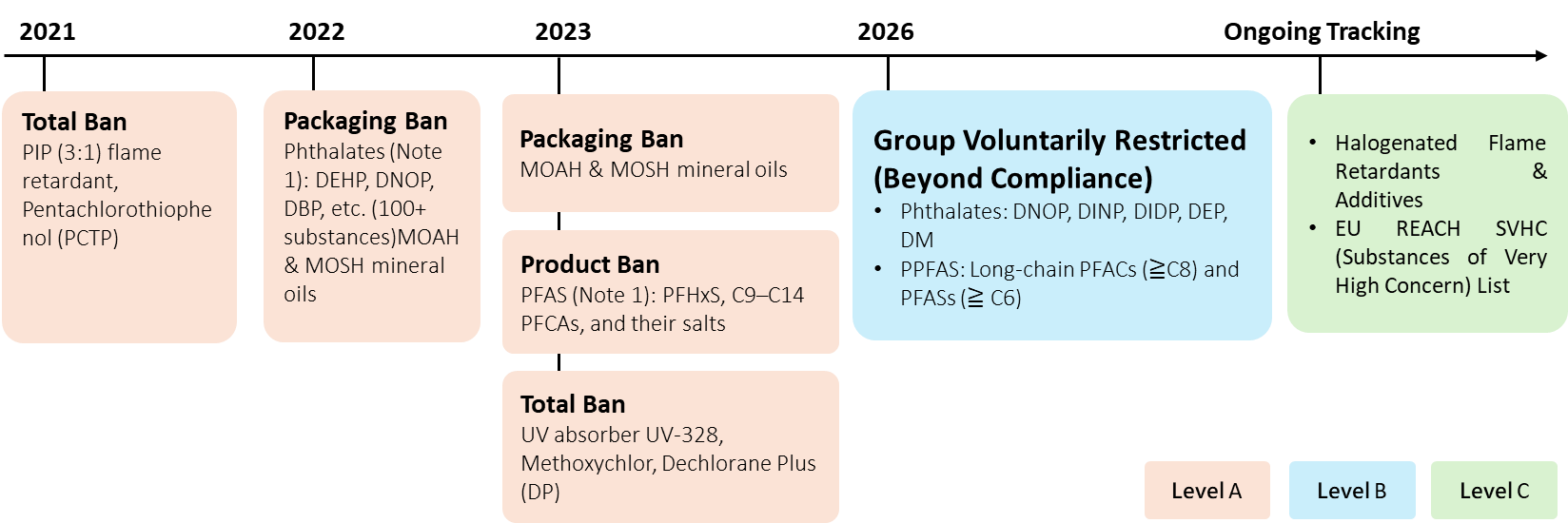
Management Status of Voluntary Substances of Concern in 2025 Main Products
Note1:There are over 100 types of phthalate chemicals, which may disrupt the human endocrine system and reproductive functions; there are over 12,000 types of perfluoroalkyl and polyfluoroalkyl substances (PFAS), which pose a carcinogenic risk to humans and are environmentally persistent and difficult to degrade. Due to the large number of substances in both categories and varying timelines for specific regulations, this summary lists key regulated items from the past five years. Detailed restrictions on hazardous substances are established in the “Regulations on Hazardous Substances and Sustainable Raw Materials” to ensure product safety and compliance.
Note2:The scope of the inventory includes motherboards, graphics cards, servers, and laptops, with statistics based on representative models.