
GIGABYTE is committed to mitigating the impacts caused by business operations on climate change. Visionary management policies and effective response plans have been adopted for effectually promoting climate-rated management and adaptation measures.
GIGABYTE released its first GIGABYTE TCFD Report independently in 2023. The Report aims to meet the expectations and information needs of stakeholders, comply with Taiwanese and international sustainability disclosure standards and regulations, and, by strengthening communication, contribute to the continuous optimization of GIGABYTEʼs climate change responses, management capabilities, operational resilience, and market competitiveness.
CDP assessment results in recent years
| Dimension | 2022 | 2023 | 2024 | 2025 |
|---|---|---|---|---|
| Climate Change | A- | A- | B | B |
| Water Security | B | B | B | B |
| Supplier Engagement | A- | A | A- | A |
Participation in Climate-Related Initiatives and Associations
- GIGABYTEʼs Role:Member
- Participation Description:As the sole global network partner of the WBCSD in Taiwan, GIGABYTE aligns with international sustainability trends. We translate our internal expertise into momentum for industry upgrades, collectively enhancing the overall resilience and sustainable core value of Taiwanʼs industries.
- Resources Invested: NT$ 90,000
- GIGABYTEʼs Role:Member
- Participation Description:By taking concrete actions toward decarbonization, we drive the low-carbon transformation of the supply chain. While responding to the requirements of international brand customers, we strengthen the focus on climate change issues among Taiwanese enterprises and various sectors.
- Resources Invested: NT$ 150,000
- GIGABYTEʼs Role:Alliance Member
- Participation Description:The alliance aims to promote the development of circular economy in Taiwan. Through forums and other activities, it builds consensus across industry, government, and academia to steer industries toward circular economy, green environmental protection, energy development, and technological recycling.
- Resources Invested: Bestyield International (GIGABYTE subsidiary) serves as the member representative, participating in all alliance actions. Serves as a demonstration case for the Industrial Development Administration (MOEA) in promoting the circular economy.
- GIGABYTEʼs Role:Alliance Member
- Participation Description:Formed by the Resource Circulation Administration (MOENV) across 8 major sectors (Food, Plastic, Textile, Health, Construction, Electronics, Inorganic Resources, and Circular Industry), this alliance fosters public-private partnerships and cross-domain collaboration to build a resource-sharing platform and enhance matching efficiency for economies of scale.
- Resources Invested: Bestyield International (GIGABYTE subsidiary) serves as the member representative, delegating personnel to attend alliance meetings chaired by the Ministry of Environment. Collaborates with partners from industry, government, and academia to explore key issues such as circular procurement, resource circulation technology projects, and the draft Circular Economy Promotion Act, providing practical recommendations.
Climate Commitment and Management
GIGABYTE has set a greenhouse gas reduction target of a 50% reduction in carbon emission by 2025 with 2009 as the base year. A separate short-term target was set in 2016 under the “333 Reduction Plan” with GIGABYTE promising to reduce carbon emissions, water consumption, and waste production by 3% each compared to the previous year. The concise targets help us track our carbon reduction progress and performance.
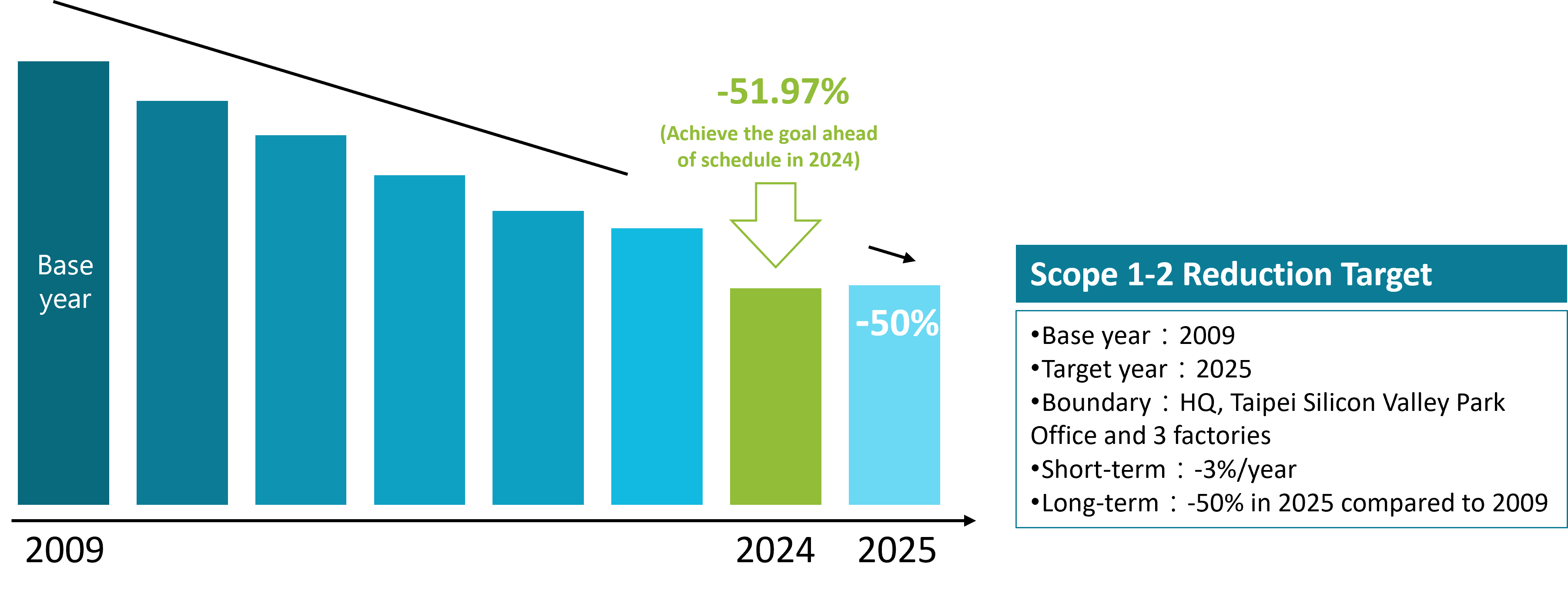
In 2024, GIGABYTE reduced its GHG emission by 51.97% compared to the base year, achieving its long-term reduction target of 50% one year ahead of schedule. In response to the global call for companies to align with the Science Based Targets initiative (SBTi), which promotes setting emission reduction goals based on scientific methods to keep global warming well below 1.5°C, GIGABYTE has taken proactive steps. Although the company has not officially announced a Science Based Target, it has adopted tools and target review standards recommended by SBTi to assess the gap between its current reduction goals and the science-based decarbonization pathway, serving as a basis for future adjustments.
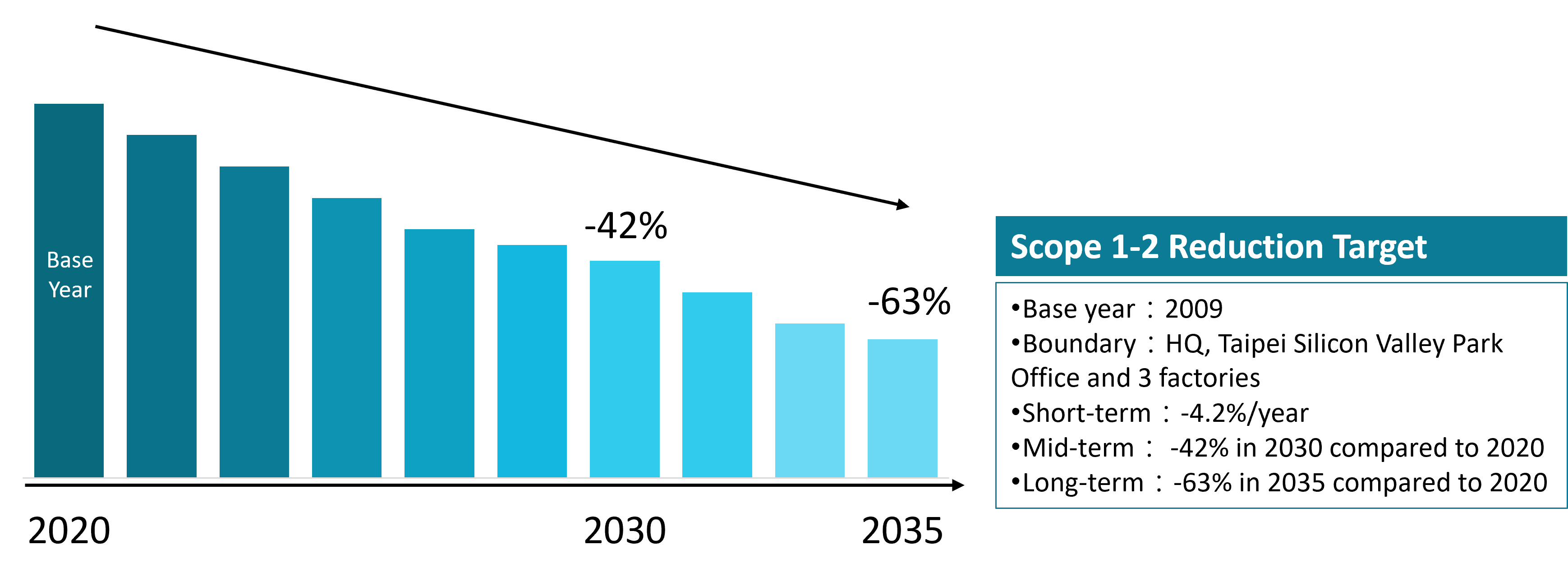
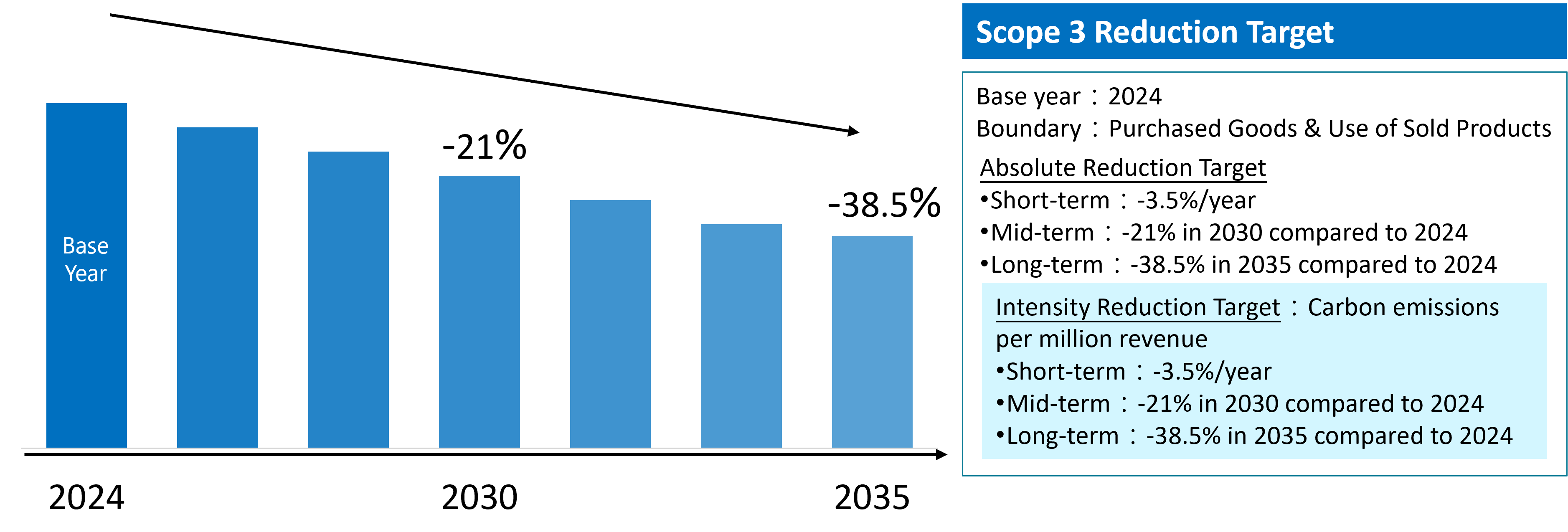
Given the early achievement of its mid- to long-term goals, GIGABYTE has updated its base year to 2020 and set new targets: a 42% reduction in Scope 1 and Scope 2 emissions by 2030, and a 63% reduction by 2035. For Scope 3 emissions, 2024 has been designated as the base year, with both absolute and intensity reduction targets established. (Due to GIGABYTEʼs recent business growth and changes in organizational boundaries for carbon inventory, it is estimated that emissions will change by more than 5% in 2026. At that time, the base year and reduction targets will be updated accordingly.)
Scope 1-2 GHG Reduction Target | Base year 2020
Scope 3 GHG Reduction Target | Base year 2024
Climate Management Strategy
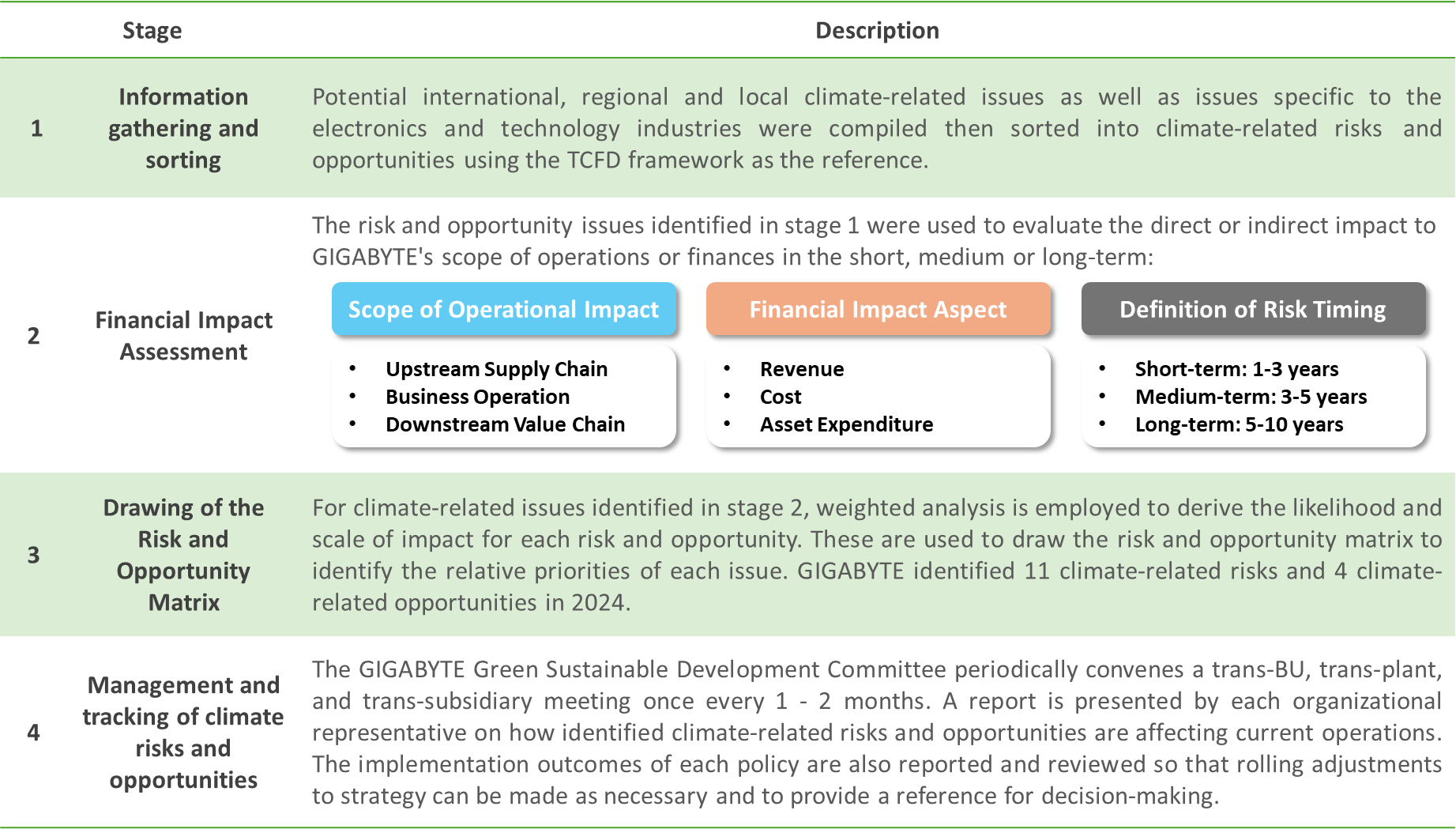
GIGABYTE has designated climate risk as a material operating risk. Climate change and global warming problems are affecting directly on the value chain as a whole from upstream suppliers to company operations and downstream demand. In addition, such sheer scope and scale of impact, there is also added urgency from the fact that human lifestyle, social culture, and economic activities around the world are already being impacted in tangible ways as well. To obtain a full picture of how climate risks may affect the Companyʼs operations or the opportunities that those may create, GIGABYTE identifies climate-related risks and opportunities that will significantly affect finances, change business strategies or models, or pose impacts on the value chain. The planning of corresponding response strategies and management measures are then prioritized. Annual reviews and re-assessments are also conducted through climate scenario analysis.
Process of Climate-related Risk Identification
Climate-related Risks and Opportunities
The following are summaries of identified climate-related risks and opportunities. For more details, please refer to the TCFD Report.
Transition Risk
Timframe:
Mid-term. Expected to be subject to carbon fee collection and regulation in 3–5 years
Impact and Scope:
- Upstream: Increased production costs
- Operatoins: Increased procurement costs
- Downstream: Impact on product prices or sales profits
Financial Impact:
Moderate, GIGABYTE has relatively low carbon emissions; the impact of carbon fees is expected to be minimal
Mitigation Measures:
Continue to monitor information related to Taiwanʼs climate regulations and adjust climate policy direction as necessary to mitigate the impact of rising costs on operations
Timframe:
Long-term. Expect European and American markets to impose carbon-related taxes on importers of electronic products and components in 5–10 years
Impact and Scope:
- Operatoins: Increased tax costs for products
- Downstream: Impact on product selling prices or sales margins
Financial Impact:
High, Depending on target market regulations, pay carbon tariffs on imported products or participate in local cap-and-trade mechanisms
Mitigation Measures:
Continuously monitor information related to international climate regulations and, if necessary, adjust climate policy direction to mitigate the impact of rising costs on operations
Physical Risk
Timframe:
Mid-term. Climate-induced drought or reduced rainfall impacts suppliers in water-stressed regions
Impact and Scope:
- Upsteam: Key component suppliers face supply disruption due to water scarcity
- Operatoins: Unstable component supply affects production schedules, delivery times, and customer trust
Financial Impact:
High, Identify procurement value at risk from suppliers in water-stressed areas
Mitigation Measures:
Conduct annual sustainability supplier assessments to evaluate suppliersʼ climate change preparedness, thereby mitigating potential climate-related risks in supply chain management
Greenhouse Gas Emissions Management
GIGABYTE has established GHG reduction targets, using 2009 as the base year, aiming to reduce Scope 1 and 2 GHG emissions by 50% by 2025. Through clear target-setting, the company monitors progress and performance in GHG reduction. In 2024, GIGABYTEʼs Scope 1 and 2 GHG emissions were reduced by 51.97% compared to the base year, achieving the long-term 50% reduction target one year ahead of schedule. Although GIGABYTE has not yet announced the submission of an application for Science-Based Targets (SBTi), the company has consistently referenced the tools and target review criteria recommended by SBTi to develop carbon reduction targets.
Scope 1 and 2 GHG Reduction Targets
In response to achieving its medium- to long-term target one year ahead of schedule, GIGABYTE updated its base year to 2020 in 2025 and set medium- to long-term targets to reduce Scope 1 and Scope 2 emissions by 42% by 2030 and 63% by 2035. GIGABYTE is driving strategic transformation and product diversification, actively expanding production capacity while collaborating with global partners to develop innovative solutions. This approach responds to and capitalizes on market trends in cloud computing, digitalization, and automation, resulting in a significant increase in production volume in recent years.
| Base Year: 2020 | Absolute Reduction Targets | Intensity Reduction Status | ||
|---|---|---|---|---|
| Target Description | 2025 Achievement Status | 2025 Achievement Status | ||
| Target Year | 2025 | 4.2% annual reduction | ⚠️Not Achieved Carbon emissions increased by 3.19% compared to the previous year |
Compared to the previous year, carbon emissions per million in revenue decreased by 18.80% |
| 2030 | Compared to the base year, 42% reduction in carbon emissions | Progress rate: 37% 15.67% reduction in carbon emissions compared to the base year |
Compared to the base year, 78.83% reduction in carbon emissions per million in revenue |
|
Note :Due to GIGABYTEʼs operational growth in recent years and changes to the organizational scope of the inventory, the base year and reduction targets will be updated according to the adjusted scope.
Scope 1 and 2 GHG Inventories Over the Past 4 Years
Unit: metric tons of CO₂e
| Scope | 2020 Base Year | 2022 | 2023 | 2024 | 2025 | |
|---|---|---|---|---|---|---|
| Scope 1 | 648.09 | 627.81 | 832.86 | 824.73 | 725.91 | |
| Scope 2 | Location Based | 28,123.84 | 27,283.64 | 26,606.40 | 22,687.85 | 23,536.32 |
| Market Based | 28,123.84 | 27,283.64 | 26,606.40 | 22,687.85 | 23,536.32 | |
| Subtotal | 28,771.93 | 27,911.44 | 27,439.26 | 23,512.58 | 24,262.23 | |
| Carbon intensity(metric tons of CO2e per million in revenue) | 0.3401 | 0.2602 | 0.2006 | 0.0887 | 0.0720 | |
Note 1:Global Warming Potential (GWP) values from the IPCC Sixth Assessment Report are used. The GHG included in the calculation are carbon dioxide (CO₂), methane (CH₄), nitrous oxide (N₂O), hydrofluorocarbons (HFCs), perfluorocarbons (PFCs), sulfur hexafluoride (SF₆), and nitrogen trifluoride (NF₃). The data has been verified by a third party in accordance with ISO 14064-1:2018
Note 2:The scope of the inventory includes: the Headquarters, the Nanping Factory in Taoyuan, the Dongguan and Ningbo Factories in China, and the Taipei Silicon Valley Park Office (subsidiaries Bestyield International, G-STYLE, Selita Precision, and the subsidiary GIGAIPC). This scope accounts for 89.56% of consolidated revenue
Scope 3 GHG Reduction Targets for Purchased Goods and Use of Sold Finished Products
To identify climate change mitigation factors, GIGABYTE has also conducted an inventory of Scope 3 indirect GHG emissions to identify emission hotspots and drive carbon reduction across the value chain. By 2025, the company will set absolute reduction targets and intensity reduction targets for the two major GHG emission hotspots within Scope 3 emissions “purchased goods” and “use of sold finished products” setting 2024 as the base year. In 2025, due to the rapid growth in market demand for AI servers (the Groupʼs consolidated revenue grew by 27% year-over-year), this was reflected in the carbon emissions from purchased components and the use of sold end-products, which increased by 30.3% compared to the previous year; When examining the unit carbon emissions per million in revenue for these two categories, the Group will be endeavor to reducing Scope 3 emissions in the future by promoting energy-efficient product design, applying for product sustainability certifications, managing suppliers, and implementing local procurement.
| Base Year: 2024 | Absolute Reduction Target | Intensity Reduction Target | |||
|---|---|---|---|---|---|
| Target Description | 2025 Achievement Status | Target Description | 2025 Progress | ||
| Target Year | 2025 | Annual 3.5% carbon reduction | ⚠️Not Achieved Carbon emissions increased by 30.31% | Compared to the previous year, 3.5% reduction in carbon emissions per million in revenue | ⚠️Not achieved Carbon emissions per million in revenue increased by 2.55% |
| 2030 | Compared to the baseline year 21% reduction | In progress 30.31% increase in carbon emissions |
Compared to the base year, 21% reduction in carbon emissions per million in revenue | In progress Carbon emissions per million in revenue increased by 2.55% |
|
Note :Due to GIGABYTEʼs operational growth in recent years and changes to the organizational scope of the inventory, the base year and reduction targets will be updated according to the adjusted scope.
Scope 3 GHG emissions of GIGABYTE in the recent 4 years
Unit: metric tons of CO₂e
| Scope 3 GHG Items | 2022 | 2023 | 2024 | 2025 | ||
|---|---|---|---|---|---|---|
| Indirect GHG emissions from transportation | ||||||
| Upstream Transportation and Distribution | 58.32 | 617.35 | 2,905.56 | 45,269.54 | ||
| Downstream Transportation and Distribution | 28,051.45 | 44,405.99 | 20,416.20 | 6,687.28 | ||
| Business Travel* | 128.35 | 548.17 | 752.83 | 792.74 | ||
| Employee Commuting* | 1,867.53 | 1,028.98 | 1,224.31 | 1,521.29 | ||
| Indirect GHG emissions from the organizationʼs use of products | ||||||
| Purchased Goods* | 892,256.60 | 1,213,983.28 | 1,075,787.90 | 1,466,315.06 | ||
| Capital Goods | 776.94 | 580.91 | 576.26 | 1,947.87 | ||
| Fuel and Energy-Related Activities |
1,217.49 | 3,188.28 | 3,908.80 | 4,691.36 | ||
| Waste Generated from Operation* |
1,238.66 | 1,911.11 | 2,238.90 | 1,920.12 | ||
| Indirect GHG emissions from the use of the organizationʼs products |
||||||
| Processing of Sold Product |
2,312.99 | 1,541.80 | 1,603.54 | 522.77 | ||
| Use of Sold Products* | ||||||
| Finished Products | 3,090,928.16 | 840,717.33 | 902,245.52 | 1,111,319.84 | ||
| Intermediate Products | 2,598,674.12 | 3,684,402.10 | 4,532,367.64 | 3,852,154.44 | ||
| End-of-Life Treatment of Sold Products* |
8,089.73 | 8,757.16 | 9,738.99 | 24,851.07 | ||
| Total |
6,625,600.33 | 5,801,682.44 | 6,550,860.89 | 6,517,993.37 | ||
| Carbon intensity (metric tons of CO₂e per million in revenue) | 61.76 | 42.42 | 24.70 | 19.34 | ||