
Since the launch of the Green Action Plan in 2009, GIGABYTE has been devoted to building employeesʼ environmental awareness in their work and life through a comprehensive and pragmatic approach. Environmental protection and sustainability should not be lofty topics but rather a kind of habit practiced every day. As for environmental performance management, GIGABYTE plans a clear long-term goal and adopts active reduction measures based on a short-term target, “333 Reduction”, aiming to reduce carbon, water, and waste by 3% per year.
The environmental performances are disclosed as below. For emissions and energy-related performance, the data boundary covers GIGABYTEʼs operation headquarters (including subsidiary Giga Computing), Taoyuan Nanping Factory, Dongguan and Ningbo Factories in mainland China, as well as the Taipei Silicon Valley Park Offices, where GIGABYTEʼs subsidiaries G-Style, Bestyield International, Cloudmatrix, and sub-subsidiary GIGAIPC are located. This coverage accounts for approximately 89.56% of the Groupʼs consolidated revenue in 2025. For water and waste performance, the data boundary covers GIGABYTEʼs headquarters building, Taoyuan Nanping Factory, Dongguan and Ningbo Factories in mainland China. The revenue from these sites in 2025 accounted for 88.94% of the Groupʼs consolidated revenue.
Performance of Environmental Management Target
Progress Tracker of Long-term Reduction Targets
Reduce carbon emissions by 50% in 2025 compared to 2009
Reduce water use by 20% in 2030 compared to 2010
Reduce waste generation by 50% in 2030 compared to 2010
Progress Tracker of 333 Reduction Plan Targets
Reduction Performance of GHG Emissions, Water, and Waste in 2025
Due to continued business growth, greenhouse gas emissions, water consumption, and operational waste for 2025 increased slightly compared to the previous year. However, the company did not meet its short-term and mid-to-long-term waste reduction targets. The main reason was a shift in market demand that led to an increase in server orders, resulting in higher production volumes and waste generation. Nevertheless, GIGABYTE continues to implement waste recycling and reduction initiatives. As a result, the amount of waste generated per NT$1 million in revenue decreased compared to both the previous year and the baseline year. The company will continue to review its reduction targets, promote internal waste reduction programs, and optimize resource utilization and recycling mechanisms to steadily progress toward its waste reduction goals.
Performance of Environmental Resource Management
Energy Conservation
Based on the ISO 50001 Energy Management System and referred to the EP100 international initiative for improving energy productivity, GIGABYTE has set targets for both “absolute reduction” and “intensity reduction” in energy consumption. By setting these targets, the company evaluates the effectiveness of various energy-saving measures and makes rolling adjustments to ensure optimal resource utilization while maintaining business growth. In 2025, total energy consumption in 2025 was 182,854.94 GJ, an increase of 5.47% compared to 2024. In terms of energy intensity, energy consumption per million in revenue in 2025 decreased by 17.00% compared to the previous year and by 70.35% compared to the base year, indicating that GIGABYTEʼs energy consumption is gradually decoupling from operational expansion, with energy efficiency improving year-over-year over the past four years.
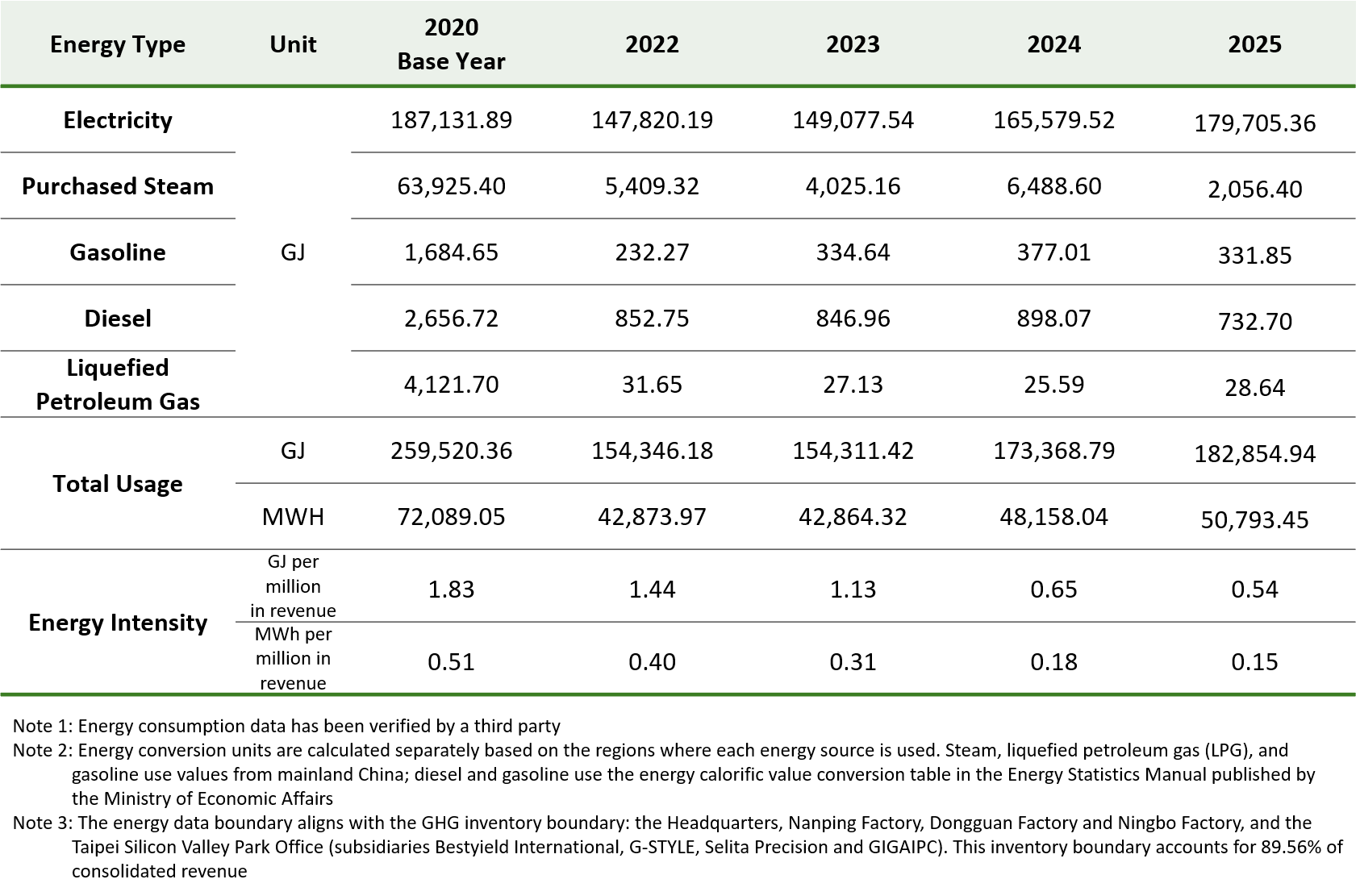
2025 Energy Conservation and Emission Reduction Projects
| Operation Base | Energy Conservation Project | Investment Amount (TWD) |
Electricity Saving (kWh) |
Energy Reduction (GJ) |
Annual Emission Reduction (t-CO2e) |
|---|---|---|---|---|---|
| Headquarters | Upgrade pumps to boost motor efficiency and implement air curtain energy-saving measures etc. | 32,799,933 | 1,036,237.35 | 3,730.45 | 474.41 |
| Nanping Factory | Optimize assembly processes to reduce power consumption, streamline production workflows, and implement heat recovery and reuse etc. | ||||
| Dongguan Factory | Deploy energy-efficient equipment and optimize/upgrade HVAC systems etc. | ||||
| Ningbo Factory | Introduce high-efficiency, energy-saving air compressor systems etc. |
Note: The performance metrics for electricity savings and energy reduction are estimated based on the difference between pre- and post-improvement conditions. Calculations are based on identical usage scenarios and account for changes in energy consumption per unit of power or operating time resulting from the replacement of old equipment with new equipment or process improvements.
Water Resource Conservation
The water resources used by GIGABYTE come from the municipal water supply system and recycled water at various operational sites (including recycled water and rainwater). The company does not draw from groundwater or other alternative water sources. Water is primarily supplied for use by employees, customers, and basic facility operations at various office locations. Since the companyʼs product lines primarily involve assembly operations rather than high-water-consumption manufacturing processes, the wastewater generated after use consists mainly of domestic sewage. None of the Companyʼs operational sites in Taiwan or China are classified as regulated sewage/wastewater facilities, and the quality of discharged water complies with local discharge standards. All wastewater is uniformly discharged into the public sewer system for treatment and has not caused any significant impact on the surrounding environment or ecology.
Regarding wastewater discharge, all of GIGABYTEʼs wastewater is domestic sewage and is legally discharged into underground sewers in compliance with local laws and regulations. Thus, it has not caused impacts on the environment and ecology around the business locations.
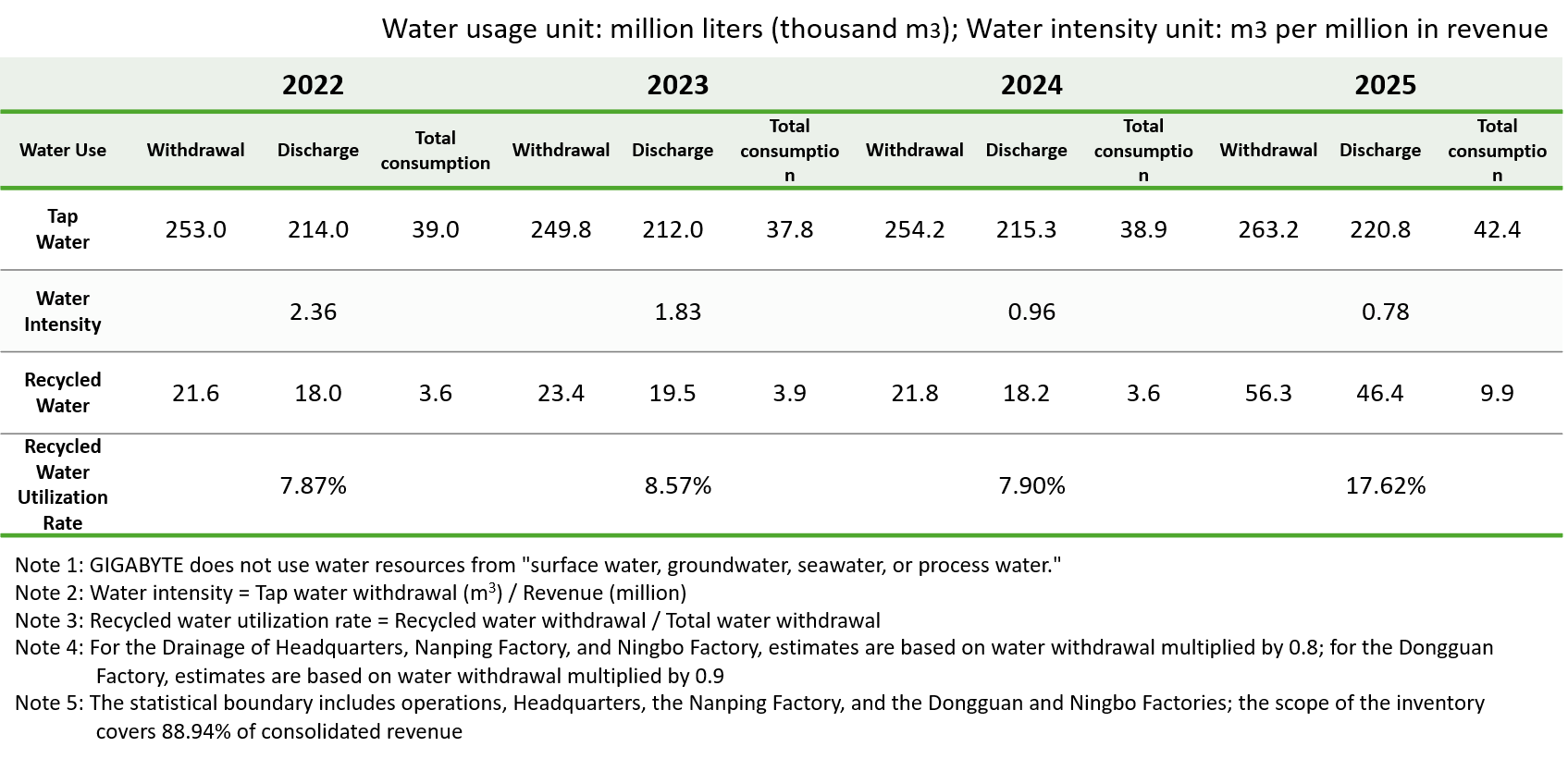
2025 Water Resource Management Measures
| Management | Key Actions | Implementation Results |
|---|---|---|
| Regular Inspections and Maintenance and Internal Audits |
|
Implement monthly water inspection operations |
| Installation of Water Recycling Equipment | Installation of equipment at the Nanping Factory, Dongguan Factory, and Ningbo Factory, including central air conditioning cooling water circulation systems and wastewater treatment circulation systems for production lines | Total recycled water volume reached 56,263 tons |
| Installation of Rainwater Harvesting Systems | A rainwater harvesting system was installed on the G-HOME GIGABYTE Eco- Rooftop to provide water for ecological irrigation within the campus, and an irrigation system was used to minimize water loss | Rainwater Recovery Volume Provides approximately 50% of annual irrigation water |
| Wastewater Quality Management |
|
All three main manufacturing sites (Nanping Factory, Dongguan Factory, and Ningbo Factory) comply with statutory effluent quality standards |
| Education and Training | New employees participate in training on environmental protection topics; we periodically use e-newsletters or other promotional materials to raise employee awareness of water conservation | 100% of new employees complete training on environmental protection topics |
Note: The implementation of equipment at each operational site is subject to the actual spatial configuration of the facility
Waste Reduction and Pollution Control
GIGABYTE complies with local regulations to properly manage operational waste, including household waste, recyclable waste, and hazardous industrial waste, and entrusts qualified contractors with collection and final disposal. All waste is tracked and reported through weight verification and proper disposal certificates to ensure transparency and traceability of information. In addition, the Company conducts regular vendor audits to strengthen compliance management and environmental risk control in waste disposal.
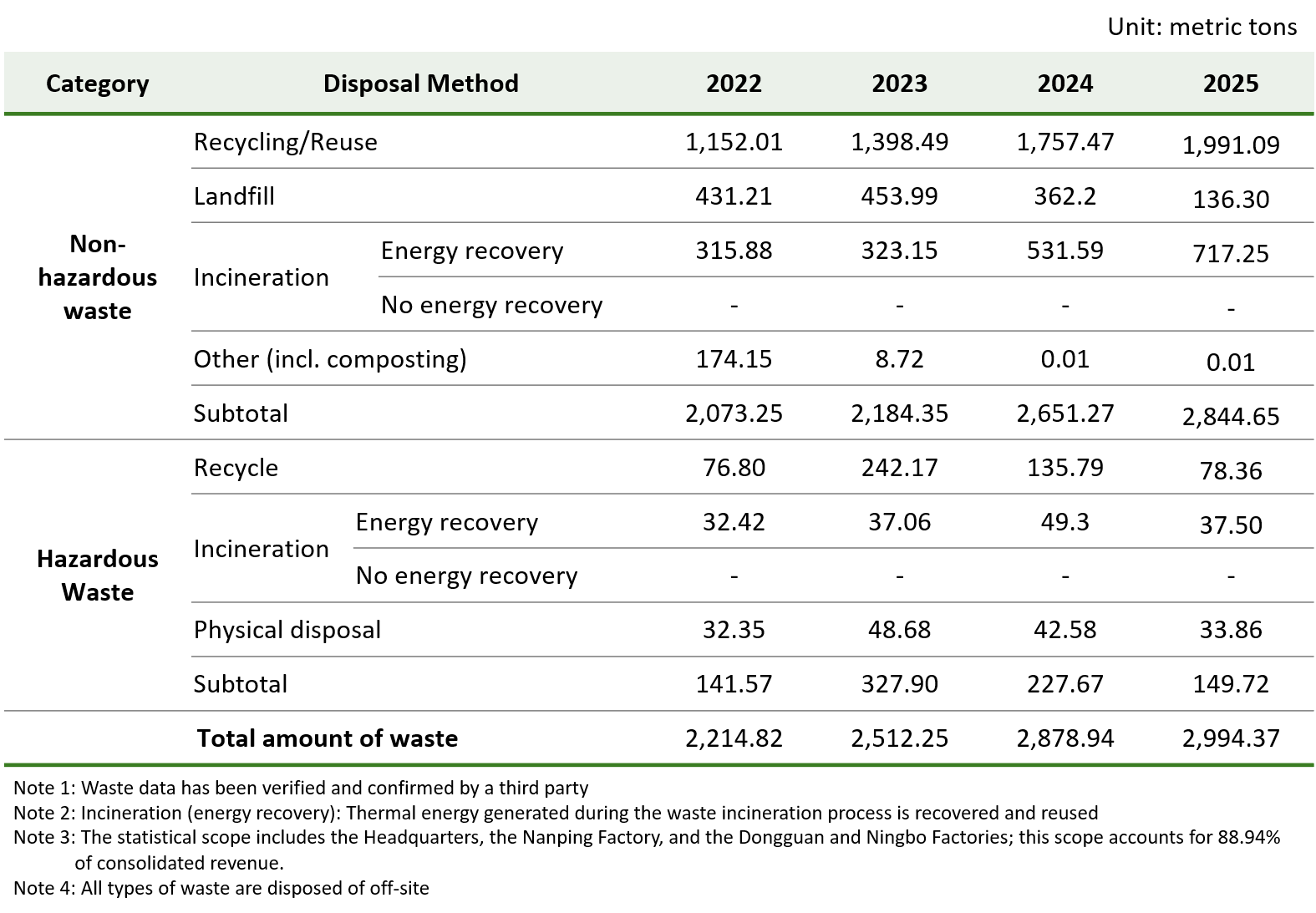
2025 Waste Reduction Management Measures
| Management | Key Actions | Implementation Results |
|---|---|---|
| Waste Reduction Incentive System | The Company continues to promote waste reduction proposals, encouraging employees to devise innovative actions to facilitate and implement waste reduction. This includes diverse reduction schemes such as reducing solvent usage, recycling packaging materials, and minimizing operational waste | A total of 15 innovative waste reduction proposals were implemented across major operational sites, resulting in a reduction of 77.57 metric tons of solid waste compared to pre-improvement levels benefits |
| Implementation of Resource Recycling Regular internal audits |
|
Recycling rate reached 69.11% |
| Waste reduction at the source Promoting the Circular Economy |
|
|
| Education and Training | New employees participate in 1–2 hours of training on sustainability-related topics; we periodically use newsletters or other promotional materials to raise employee awareness of recycling and waste reduction | 100% of new employees complete sustainability-related training |
VOCs Management
Volatile Organic Compounds (VOCs) are one of the primary sources of poor air quality. GIGABYTEʼs air pollution control measures comply with regulatory standards in Taiwan and China. Furthermore, as our factories primarily utilize low-pollution assembly processes, there are no emissions of NOx, SOx, or PFCs. Due to the nature of their manufacturing processes, GIGABYTEʼs facilities in China have installed dedicated equipment for paint waste treatment and electronic waste disposal to effectively address xylene and non-methane hydrocarbon emissions. VOC emissions are monitored regularly; the combined monitoring data for both facilities totaled 0.968 metric tons, which complies with regulatory standards and represents a 23.36 % decrease compared to the previous year.
| Factory | 2022 | 2023 | 2024 | 2025 |
|---|---|---|---|---|
| Nanping Factory | No emissions | No emissions | No emissions | No emissions |
| Dongguan Factory | 0.561 | No emissions | No emissions | 0.577 |
| Ningbo Factory | 1.749 | 0.975 | 1.263 | 0.391 |
| Total | 2.310 | 0.975 | 1.263 | 0.968 |
Note 1: Unit-Metric tons
Note 2: The inventory boundary accounts for 100% of consolidated revenue
Sustainability and Environmental Education Promotion
Over the past decade, the Green Action Plan has delivered a variety of services: knowledge-oriented activities such as seminars, workshops, and newcomer training; experience-oriented activities such as working holidays, a green volunteering club, drawing and photography contests; custom-oriented measures like vegetarian food promotion, waste reduction – which have effectively promoted employees to develop more sustainable lifestyles and cultivate their environmental protection concepts; call on suppliers of “Reduction. Sharing. Love the Earth” Alliance to join the “333 Reduction Plan” and environmental protection activities to guard the planet together.
For further details, please refer to Sustainability and Environmental Education.
For further details, please refer to Tetralogy of Supply Chain Engagement.
Besides the internal environmental education, the G-HOME GIGABYTE Sustainable Eco-Roof, founded in 2013, also promotes the benefits of rooftop greening by opening it to external visitors. Between 2017 and 2022, G-HOME received the Environmental Education Facility and Field Certification from the Environmental Protection Administration. The two certificated environmental education courses, Rooftop Greening is not A Dream and The World is a Circle, are developed to promote the concepts of sustainability, co-prosperity, and zero waste to the public, industries, government, and academia. Moreover, we look forward to seeing more sustainable eco-roofs being constructed to make Taiwan greener and healthier.
Sustainability and Environmental Education Hours in the Recent 5 Years
- Home
- Innovation Management
- Product Energy Efficiency Management
- Product Packaging Management
- Raw Material Management
- The Guanxi Blue Zone
- The Ocean is Our Home
- From the Chairman
- Commitment to CSR
- Stakeholder Engagement
- Material Topics
- SDGs
- Corporate Organization
- Code of Conduct
- Information Security & Privacy
- Risk Management
- Supply Chain Management
- Tetralogy of Supply Chain Engagement
- Conflict Mineral
- Environmental Management Policy
- Brand Strategy and Business Reputation Management
- Climate Strategy and Risk Management
- Customer Relations Management
- Eco-friendly Product
- Hazardous Substance Management
- Biodiversity
- Circular Economy
- Green Action
- Sustainability/Environmental Education
- Green Activities
- Working Holiday
- Corporate Volunteering
- Go Green Taiwan
- Make Earth Green Again
- Tree Map
- Overview/Core Concept
- Rooftop Farm
- Ecology Photo Competition
- Resource Hub
- Diverse and Inclusive Workplace
- Talent Management
- Human Rights Management
- Talent Cultivation and Development
- Occupational Safety
- Health Care
- Upgrade Your Life
- Social Inclusion
- CSR Milestone
- Economic Aspect
- Environmental Aspect
- Social Aspect
- CSR Report